
How long will it take to say?
Type the word count of your draft. We use 130 words per minute as our assumption for speaking pace.
Each example below has its own Copy button.
Most couples expect the maid of honor to say a few words, and three minutes is the right size. This page gives you a five-part outline with seconds for each part, ten openers to copy, and a full short example.
Use the copy buttons on any example, edit the names, and read it aloud once with a timer. Everything stays in your browser.
Outline table of five speech parts, with seconds
Every good maid of honor speech has the same five parts. The only real decision is how long each one gets. This table sets a three-minute budget and converts it to words.
Table: Five speech parts for a three-minute maid of honor speech (our estimate at 130 words per minute)
| Part | What goes in it | Seconds | Words |
|---|---|---|---|
| 1. Opening | Your name, how you know the bride, thanks in one line | 20 | 43 |
| 2. The story | One specific moment that shows who she is | 55 | 119 |
| 3. The partner | What you have seen since they met | 35 | 76 |
| 4. The wish | A short hope for their marriage | 40 | 87 |
| 5. The toast | Ask the room to raise a glass | 30 | 65 |
| Total | 180 | 390 |
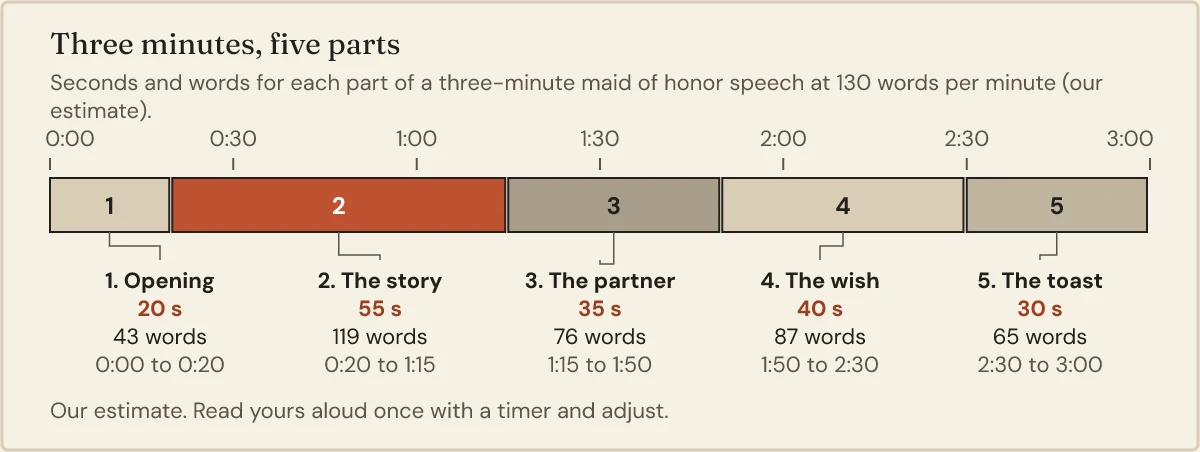
Example: where the time goes (estimate)
Pace is our assumption of 130 words per minute, a little slower than everyday talk because you will pause for laughs and nerves. The story gets the biggest share, 55 seconds, because it is the part guests remember. The toast looks long at 30 seconds, but it holds your thanks, the wish to the room, and the pause while people lift glasses.
If your story needs more room, take seconds from the wish, not from the partner. The partner part is the one the groom or second spouse is waiting to hear.
The story gets 55 seconds and the wish 40, so the two together fill about half of the three minutes.
Published guidance varies on total length. WeddingWire says to stay under five minutes and aim nearer three. Bridebook, a UK site, suggests four to six minutes for a maid of honour. We chose three because a dinner crowd is usually restless by minute four, and because a short speech is easy to rehearse until it feels natural.

Ten ways to start a maid of honor speech
You do not need a clever opening. You need one that gets you from “hello” to your story without a long walk. Each opener below is a standalone example with placeholders. Change the brackets, keep what sounds like you.
Opener 1, warm and plain (39 words)
Hi, everyone. I’m [Name], and I have been [Bride]‘s best friend since [year or age]. That makes me the person who knows her best and the one she trusted with the microphone tonight. I will try to deserve it.
Opener 2, name the job (27 words)
Good evening. The maid of honor’s job is to say something true, keep it short and sit down before dessert melts. I will try for all three.
Opener 3, a first memory (26 words)
The first thing [Bride] ever said to me was [her first words]. That was [number] years ago, and she has never really left my side since.
Opener 4, for a sister (40 words)
I have known [Bride] my whole life, which is exactly as long as she has been telling me what to do. She taught me to ride a bike and to tell the truth. Only one of those stuck right away.
Opener 5, the phone call (36 words)
I remember the phone call. [Bride] said, “I met someone,” and I could hear it in her voice before she said [Partner]‘s name. I knew then that this was not going to be a short story.
Opener 6, thank the hosts (38 words)
Thank you all for being here. To both families, thank you for this beautiful room and this beautiful night. I’m [Name], and I am the one holding the microphone, the notes and, if things go badly, the tissues.
Opener 7, very short (16 words)
I’m [Name], maid of honor. I have three minutes, one story and one toast. Let’s begin.
Opener 8, a question (30 words)
How do you describe a person who always shows up? I will tell you about the night [Bride] showed up for me, and then I will tell you about [Partner].
Opener 9, in on the secret (28 words)
Most of you know how [Bride] and [Partner] met. Fewer of you know I was in the room that night, holding a drink I had no business ordering.
Opener 10, for a nervous speaker (29 words)
I’m not a public speaker, so I wrote this down. If I cry, please clap. If I stop, please clap louder. Either way, I’m so happy to be here.
A full three-minute example you can adapt
This one follows the outline table, part by part. The story is invented, so swap in your own. Keep the shape: a small problem, a calm reaction, then what it says about her.
Full example, about three minutes (about 390 words)
Good evening, everyone. I’m [Name], [Bride]‘s maid of honor, and I have known her since [year or age]. Before I say anything else, congratulations to you both, and thank you to every family who made this room happen.
When [Bride] moved into her first apartment, I drove four hours to help. The truck broke down twice. She did not complain once. She made a playlist for the breakdown, found a diner that served pie at ten at night, and called her landlord to say we would be late. By the time we arrived, she had made the landlord laugh and made me feel like the trip was the best part of the move. That is [Bride]. She turns problems into plans, and plans into stories. I have watched her do it for [number] years. When I lost my job, she showed up with soup and a spreadsheet of ideas. When her own plans fell through, she called me first, and then she made a new plan before we hung up. She is the friend who says the hard thing kindly and stays for the answer.
[Partner], I want you to know what I saw. The first time you two were in a room together, she stopped narrating and started listening. I had never seen that before. You make her quieter in the best way, and she makes you braver. Each of you is better with the other in the room, and everyone here can see it.
So here is my wish for you both. Keep making the playlist for the breakdown. When the truck stops, find the pie. Say sorry quickly and mean it. Laugh at the same things, and at each other when it is safe. Love is mostly showing up on the boring Tuesdays, and I have never known two people better at Tuesdays than you. When the big days come, and there will be many, remember that the small ones are the marriage. Cook dinner badly together. Walk the long way home. Keep telling each other what you noticed today.
Everyone, please raise a glass. To [Bride] and [Partner]. May your road be long, your breakdowns be short, and your kitchen always have pie in it. Thank you for letting me be part of your story. I love you both. To the happy couple.
What not to say about the couple
Most speeches that go wrong fail in the same few places. Each item here comes with the reason, so you can judge edge cases yourself.
- Exes and past relationships. The room includes the partner’s grandmother. A story that needs an ex to work will not survive her face.
- Anything the couple would not post. If you would not show it to both families on a screen, leave it out. Private jokes belong in a text, not a toast.
- Drinking, hangovers and the bachelorette trip. One knowing nod is fine. A recap puts the partner’s family in an awkward spot.
- Advice about marriage you have not lived. A wish lands better than a lecture. Say what you hope for them, not what they should do.
- Jokes about the partner that the bride has not approved. You are a guest in a new family. Tease your friend, not their spouse.
- A list of thank-yous. The couple and the hosts will thank people. Your slot is for the story.
- Reading the whole thing from your phone. A screen glare and a scrolling thumb make you look away from the couple. Use a printed card.
- Going over your slot. Dinner is waiting, and the best man, parents or couple may follow you.
Make it yours in four questions
A template only works if the story is real. Spend ten minutes on these before you write a word.
- What is the smallest moment that shows who she is? Pick a trip, a text, a phone call. Small beats grand.
- What did you notice the first time you saw her with her partner? One sentence is enough.
- What would the couple laugh at, and the grandparents too? Keep jokes to that set.
- What do you want the room to feel in the last ten seconds? Warm, proud, hopeful. Write toward it.
Then match it to your relationship. If she is your sister, the history is the story, and our page for a sister’s maid of honor speech shows how to handle shared childhood. If you are a best friend, the awkward part is the new partner you may not know well, which the best friend page covers.
Minutes to words for your draft
Most people write by feel and find out the length on the day. Convert first. This table shows words for each length at three speaking paces, so you can check a draft you have already typed.
Table: Words needed per speech length at three paces (our estimate, assumptions below)
| Length | 110 words per minute | 130 words per minute | 150 words per minute |
|---|---|---|---|
| 2 minutes | 220 | 260 | 300 |
| 3 minutes | 330 | 390 | 450 |
| 4 minutes | 440 | 520 | 600 |
| 5 minutes | 550 | 650 | 750 |
| 6 minutes | 660 | 780 | 900 |
The 150 column matches everyday conversation, and 110 is close to the median we saw for practice speakers. We use 130 for planning because a toast has pauses for laughter and a glass. When you are nervous, you rush. Plan for 130, then read aloud and see where you land. For a quick check, use the words to minutes calculator.
If your draft runs long
Cutting is the real writing. Here is a worked example of trimming a draft from four minutes to three.
Example: trimming a 520-word draft to 390 words (estimate)
At 130 words per minute, 520 words is four minutes. Three minutes is 390 words, so you need to lose 130 words. One way to do it:
- Cut the second story and keep the stronger one: about 90 words saved.
- Shorten the thank-you in the opening to one line: about 20 words saved.
- Trim two sentences from the wish: about 20 words saved.
Total: 130 words saved, and the draft lands at three minutes.
Cut a whole story before you thin every paragraph. A single clear story is easier to say and easier to remember than two half ones.
Where your speech fits in the evening
Order is the couple’s call. In the traditional US order, the best man speaks first and you speak second. Inside Weddings notes that a companion toast from the maid of honor is increasingly customary, and that speakers should confirm the list and order with the couple in advance. Our page on the order of wedding speeches lays out a running order with minutes per speaker.
Speaking right after the best man, check what he is planning. If he tells the college story, yours should be a different one. If you plan a funny opener, make sure his is not the same joke. Read the best man speech guide to see his outline, or send him yours.
Send the outline for a read
A second pair of ears catches the line that sounds meaner than you meant. Copy one of these into a message and attach your draft.
Hi [Name], I am working on my maid of honor speech and the plan is three minutes. Could you read it and tell me if any line feels off or too long? I will bring a printed card on the day.
Hi [Best man], I am giving the maid of honor speech after yours. Here is my outline with the story I plan to tell. Can we compare so we do not repeat each other?
You are not asking permission. You are making sure the two of you sound like parts of the same evening. For a short toast version, see the wedding toast guide, and for the full set of role guides, browse all wedding speech guides.
If your draft is still rough, the maid of honor speech template gives you a fill-in version with the same five parts.

Save for later
Pin it now and find it when you are ready to plan.
Questions people ask
Does the maid of honor give a speech?
Usually yes, but the couple decides. A toast from the maid of honor is increasingly customary, and in the traditional US order she speaks right after the best man. If nobody has asked you, check with the couple before you plan to stand up.
How long should a maid of honor speech be?
Aim for three minutes, which is about 390 words at our assumed pace of 130 words per minute. Published advice ranges from under five minutes in US guides to four to six minutes in a UK one. Shorter is rarely a problem, and longer often is.
What should a maid of honor speech include?
Five things. Say who you are and how you know the bride, tell one specific story, speak to the partner, give a short wish for the marriage, and end with a toast. The outline table above gives each part a time budget so the story does not swallow the rest.
How do you start a maid of honor speech?
Start by saying who you are in one sentence, then go straight to a small detail or a short story. Skip a long thank-you list and skip dictionary definitions. The ten openers on this page show different tones, from warm to funny to nervous, and you can copy any of them.
Should a maid of honor speech be funny?
A light touch is enough. One gentle laugh, ideally about something the couple would laugh at too, beats a string of jokes. Aim the humor at yourself or at a harmless habit of the bride. If you have to ask whether a joke is safe, cut it.
Sources
- www.insideweddings.com/news/expert-advice/the-must-know-rules-for-making-a-wedding-toast/1622 (opens in a new tab) : A companion toast from the maid or matron of honor is increasingly customary, and speakers should confirm the speaker list and order with the couple in advance.
- weddingwire.com/wedding-ideas/who-gives-a-speech-at-a-wedding (opens in a new tab) : Traditional US reception order puts the best man first, then the maid of honor, then the hosting parents. Any wedding speech should stay under five minutes, nearer three if possible.
- bridebook.com/uk/article/how-long-should-a-wedding-speech-be (opens in a new tab) : UK-oriented guidance of 4 to 6 minutes for a maid of honour speech, and 20 to 30 minutes for all speeches combined.
- virtualspeech.com/blog/average-speaking-rate-words-per-minute (opens in a new tab) : Conversational English runs about 150 words per minute, and practice speakers had a median near 111. Our 130 words per minute is our own assumption between the two.
Updated by bigdaydesk editorial
Speeches by role
-
Maid of honor speech for best friend: one story and one toast
Covers the awkward part: mentioning a partner you know less well without making the speech about yourself.
-
Maid of honor speech template: fill in five blanks
Five fill-in sentences build the full speech, with an ending that hands off to the toast.
-
Maid of honor speech ideas: funny, sweet and short
An idea bank sorted by tone, each idea with an opening, a middle story prompt and an ending line.


Keep planning
-
Write best man speech
The role landing: a five-part structure with timings, ten opening lines and a short what-not-to-say list with reasons.
-
Curious about father of the bride speech?
Covers the groom welcome and the toast, which this role must handle and others skip, with eight timed openings.
-
Covers the awkward part
Covers the awkward part: mentioning a partner you know less well without making the speech about yourself.
-
Write your vows examples
The broad collection: twenty originals across funny, short, traditional, emotional and modern, each with a word count and a time.


